
You are here
Round table: Integrating the CSD-Discovery Software Package into the Educational Process. The Experience of the Institute of Food Biotechnology and Genomics of the NAS of Ukraine
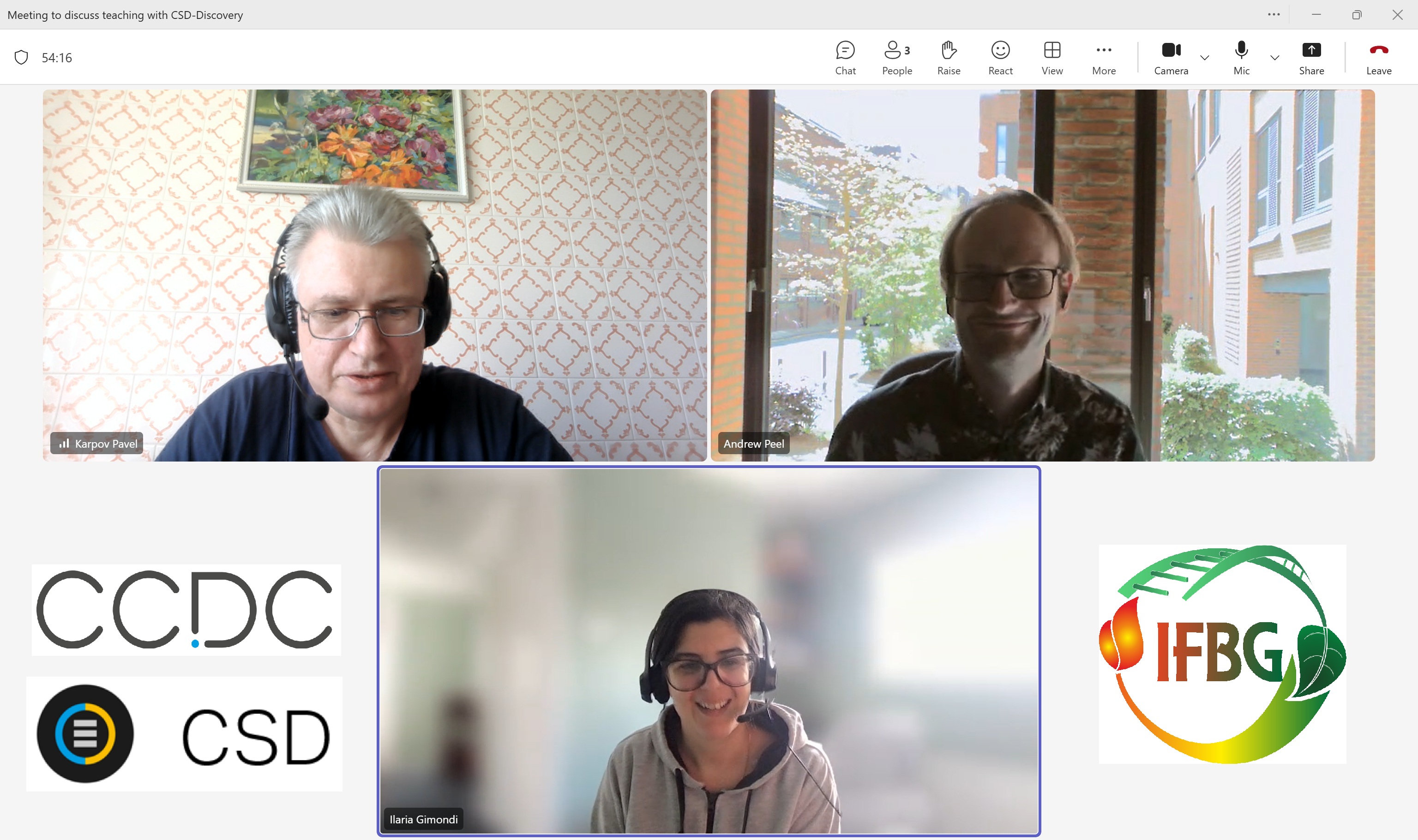 |
On May 15, 2026, an online round table discussion was held via a network conference, dedicated to the application of the CSD-Discovery software package of The Cambridge Crystallographic Data Centre (CCDC) in the educational process. The experience of our Institute in using CSD/CCDC programs and information resources, specifically the CSD-Discovery package, in training postgraduate students of the Institute and students of Taras Shevchenko National University of Kyiv was reviewed. Future opportunities for institutional cooperation within the educational process were also discussed. |
Participants:
- Dr. Andrew Peel — Education and Outreach Officer at The Cambridge Crystallographic Data Centre (Cambridge, England, United Kingdom).
- Dr. Ilaria Gimondi — Education and Outreach Officer at The Cambridge Crystallographic Data Centre (Cambridge, England, United Kingdom).
- Dr. Pavel Karpov — Head of the Laboratory of Bioinformatics and Structural Biology, Department of Genomics and Molecular Biotechnology, Institute of Food Biotechnology and Genomics of the NAS of Ukraine (Kyiv, Ukraine).
The Cambridge Structural Database (CSD) is the world's largest repository of three-dimensional crystallographic structures of small organic and organometallic molecules. The CSD is officially curated by the Cambridge Crystallographic Data Centre (CCDC), which also develops advanced scientific software. The package CSD-Discovery suite offers comprehensive capabilities for the deposition, analysis, and management of crystallographic data archive. Furthermore, it incorporates various software applications for structural biology and bioinformatics research, including:
- GOLD for protein-ligand docking;
- CrossMiner for pharmacophore searching;
- Hermes for three-dimensional visualization, editing, and analysis of macromolecules;
- ConQuest for information retrieval within the CSD database;
- Mercury for the visualization and analysis of three-dimensional crystal structures,
etc.
Since 2023, within the framework of the Frank H. Allen International Research and Education (FAIRE) Programme, our Institute has been granted full access to the CSD/CCDC resources and software (the license was issued to Dr. Pavlo A. Karpov) for academic research and educational purposes.
 Українська